

Online Typing Work From Home for Students: What I Wish Someone Had Told Me
In my second semester, I paid Rs. 2,500 to a stranger on WhatsApp because he promised me Rs. 40,000 a month for “simple typing work from home.” I never saw that money again. The number went dead, the “company portal” login stopped working, and I felt like an idiot for weeks.
If you’re searching for online typing work from home for students, I understand exactly why. You need money, you have a laptop or even just a phone, and typing sounds like something anyone can do. No degree required, no experience, no investment. It sounds perfect. That’s exactly why it’s also the most lied-about “opportunity” on the internet.
I’ve spent enough time in this space now — trying platforms, talking to people who actually do this work, and yes, getting burned once — to tell you the full honest picture. What’s real, what’s a scam, what it actually pays, and how to start without losing money. No fake promises. Let’s get into it.
The Truth About Online Typing Work for Students
Here’s the uncomfortable truth first: about 90% of “typing job” ads you see on Facebook, WhatsApp groups, and classified sites are either scams or pay so little they’re not worth your time.
The classic scam works like this. You see an ad: “Earn Rs. 30,000–50,000/month from home! Just copy-paste work! No experience needed!” You message the number. A friendly “HR manager” replies, sends you a company-looking brochure, maybe even a fake registration certificate. Then comes the catch: a “registration fee,” “security deposit,” or “software activation charge” — usually Rs. 1,000 to Rs. 5,000, payable via Easypaisa or JazzCash. You pay. They give you some typing task. You submit it. Then they reject your work for “too many errors” and ask for another fee to “reactivate” your account. Or they just block you.
I know this pattern because I lived it. The Rs. 2,500 I lost in my second semester still annoys me — not because of the amount, but because I was so sure I’d found a shortcut.

But here’s the other side of the truth, the part that matters: real typing work does exist. It’s just quieter, harder to get into, and pays far less than the scam ads promise. Real clients don’t advertise on WhatsApp with “100% payment guarantee.” They’re on freelancing platforms, they test your skills, and they pay modest rates — especially at the start.
Once I understood this, everything changed. Let me show you what the real landscape looks like.
What Real Typing Work Actually Looks Like
Forget the fantasy of “type 2 hours, earn lakhs.” Real typing work falls into a few boring, legitimate categories:
1. Data entry. A business has a pile of information — customer details, product lists, survey responses — sitting in papers, PDFs, or images. They need it typed into Excel sheets or their software. This is the most common real typing job. It pays per project or per hour, and it’s mind-numbingly repetitive. But it’s real.
2. Transcription. You listen to audio — interviews, meetings, lectures, podcasts — and type out what you hear. Platforms like Rev and TranscribeMe hire for this. It pays better than basic data entry because it needs concentration, good English listening skills, and accurate punctuation. Beginners are slow at it. I was terrible at first.
3. Copy typing. Someone has a scanned book, a handwritten document, or a PDF, and they need it retyped into Word or Google Docs. Bloggers, authors, and small businesses post these jobs on Fiverr and Upwork.
4. Captcha typing. You type distorted characters all day for fractions of a paisa each. I’m including this so I can tell you clearly: don’t bother. The pay is insultingly low — we’re talking maybe Rs. 100–200 for hours of eye-straining work — and most captcha sites are sketchy anyway. Every “captcha entry job” ad promising daily thousands is lying.
5. Content formatting. This one’s underrated. Bloggers and content creators hire students to take their rough drafts and format them properly — headings, bullet points, bold text, fixing spacing. If you know basic Google Docs or MS Word formatting, you can do this. It pays better than raw typing because fewer people offer it.
Notice something? None of these involve “just copy-paste and get rich.” They’re all actual services for actual clients. That’s the filter: if there’s no real client with a real business need on the other end, it’s probably a scam.
Platforms I Actually Tried (And What Happened)
Let me walk you through the platforms I personally tested, with what actually happened — not marketing copy.
Fiverr. I made a gig titled “I will do fast and accurate data entry and copy typing.” My first order took three weeks to arrive. It was a $5 job — typing 20 pages from a scanned PDF into Word. It took me an entire evening. After Fiverr’s cut, I got about $4. Was it life-changing? No. But it was real money for real work, paid to my account, no registration fee, no drama. Over the next two months I picked up a few more small orders. The lesson: Fiverr works, but you start at the bottom, your gig title needs to be specific (not “I will type anything”), and you need patience.
Upwork. Harder. You bid on jobs against people from everywhere, and as a beginner with no reviews, most clients ignore you. Upwork also uses “connects” — you get a limited number free, then you pay. I sent maybe 15 proposals before getting a reply, and that job was data cleanup in Google Sheets for $15. My honest take: Upwork is better once you have some experience and samples. Don’t start here on day one.
TranscribeMe. I signed up, took their entrance test, and passed on the second try. (I failed the first attempt because my punctuation was sloppy — they care about that a lot.) The work is short audio clips, 2–4 minutes each. The pay per audio hour sounds okay until you realize a beginner takes 4–6 real hours to transcribe one audio hour. My first week I earned roughly $8 for several evenings of work. It’s honest work and they do pay via PayPal, but go in with realistic expectations: it’s slow money at the start, faster as you improve.
Rev. Stricter than TranscribeMe. Their entrance test is genuinely hard — grammar, formatting rules, verbatim vs. clean transcription. I failed it the first time and didn’t retry for months. If your English is strong, it’s worth attempting, because Rev’s pay is better than most. If your English is average, build up on easier platforms first.
Clickworker. Micro-tasks — categorizing data, short writing tasks, surveys. The pay per task is tiny, but tasks are quick and the platform is legitimate. I used it more to understand what “micro work” feels like than as a real income source. Fine for pocket money, not a job replacement.
The pattern across all of these: legitimate platforms never ask you for money to join. That’s the single brightest line between real and fake. Fiverr, Upwork, Rev, TranscribeMe, Clickworker — all free to sign up. Any “typing job” asking for a registration fee is a scam. Every single time.

How to Start Online Typing Jobs for Students: Step by Step
Okay, practical part. If I were starting from zero today, here’s exactly what I’d do:
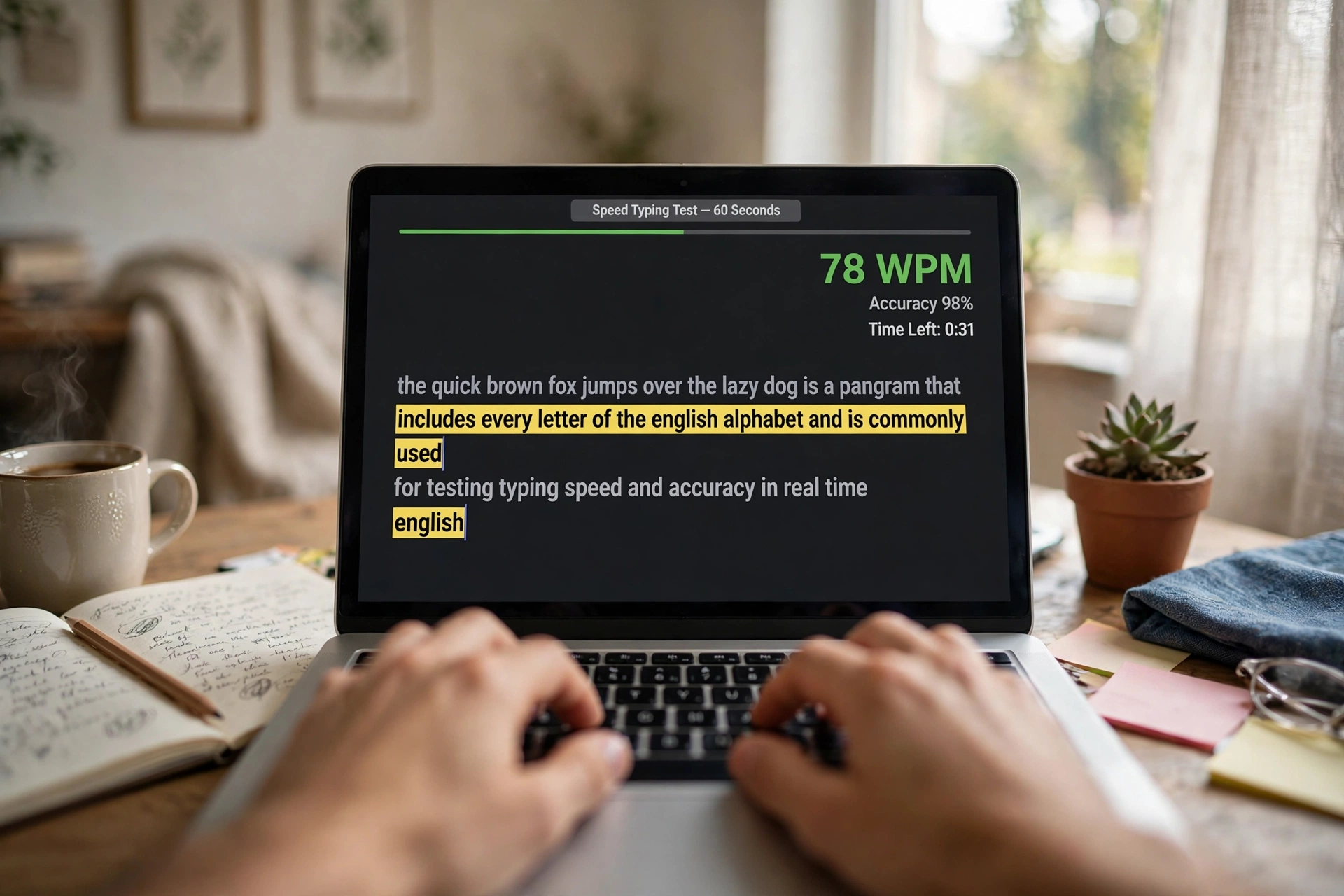
Step 1: Fix your typing speed first. Go to a free site like keybr.com or typing.com and test yourself honestly. If you’re below 35 words per minute, practice 20 minutes a day for two weeks before applying anywhere. Clients can tell when you’re slow — missed deadlines kill your account faster than anything. Aim for 40+ WPM with decent accuracy. This is the one “investment” that’s free and actually matters.
Step 2: Get comfortable with Google Docs. You don’t need paid software. Learn the basics properly: styles and headings, bullet lists, tables, find-and-replace, and exporting to Word/PDF. Half the “typing jobs” out there are really “typing + basic formatting” jobs, and the formatting part is what lets you charge more than the bottom rate.
Step 3: Create a Fiverr account and make ONE specific gig. Not “I will do typing work” — that’s invisible among ten thousand identical gigs. Something like “I will accurately transcribe your audio or retype your PDF into Word within 48 hours.” Specific beats generic. Write the gig description in clear, simple English. Set your first price low ($5–10) to get those crucial first reviews.
Step 4: Make 3 sample pieces. Before anyone hires you, make samples: one cleanly formatted Word document from a messy PDF (use any public-domain text), one short transcription sample, one data-entry spreadsheet. Put them in a Google Drive folder with view access. Link it in your gig and proposals. Samples beat promises every time.
Step 5: Apply to 5 jobs a day, and track everything. On Fiverr, that’s buyer requests. On Upwork, proposals. Keep a simple Google Sheet: date, platform, job title, rate offered, status. Most applications get ignored — that’s normal, not personal. In my experience, roughly 1 in 10–15 applications turned into a conversation when I was new. The spreadsheet stops you from feeling like “nothing is working” when actually you’re just on application #6.
Step 6: Over-deliver on your first 3 jobs. Deliver early. Double-check your work. Communicate politely. Ask for a review when the job is done well. Those first few 5-star reviews are worth more than any course or certificate — they’re what get you job #10, #20, #50.
That’s it. No secrets, no hacks. It’s slow, slightly boring, and completely real.
How Much Can You Realistically Earn? (Honest Numbers)
I won’t give you a fake fixed number, because anyone who says “earn Rs. X guaranteed” is selling you something. Here’s what’s realistic based on what I’ve seen:
- First month: Maybe $10–30 (roughly Rs. 3,000–8,000). You’re slow, you have no reviews, you’re learning. Some people earn zero the first month. That’s normal.
- Months 2–3: $50–150/month is achievable if you’re consistent — a few repeat clients, better speed, a couple of good reviews.
- After 6 months of steady work: $150–300/month part-time is realistic for a student doing this 1–2 hours a day. Full-time freelancers earn more, but you’re a student — your degree comes first.
Compare that to the scam ads promising Rs. 40,000–50,000/month from day one with “no experience.” If that were real, nobody would attend university. The honest path pays less at first and compounds. The dishonest path takes your registration fee and disappears.
One more honest note: typing alone has a ceiling. The students I know who earn the most started with typing/data entry and then added adjacent skills — basic Excel, Canva designs, social media management, simple video captions. Typing gets your foot in the door; skills get you paid.

7 Mistakes That Will Cost You Money
Learn from other people’s losses, including mine:
1. Paying any upfront fee. Registration fee, security deposit, software charge, “account activation” — whatever they call it, it’s a scam. Real clients pay you. You never pay them. This rule alone would have saved my Rs. 2,500.
2. Believing fixed income promises. “Rs. 40,000/month guaranteed” is mathematically absurd for unskilled typing work. Real freelancing income varies. Anyone guaranteeing a fixed high number is lying.
3. Wasting weeks on captcha mills. They pay almost nothing and eat your time and eyesight. If a site’s main pitch is captcha typing, close the tab.
4. Sharing sensitive documents with strangers. No legitimate typing client needs your CNIC photo, your bank login, or an OTP from your phone. Ever. This is how identity theft starts.
5. Submitting sloppy work. One bad review early on can bury your profile for months. Read your work once before submitting. Use Google Docs’ spell check. It takes five minutes and saves your reputation.
6. Quitting after one week. Everyone’s first week is slow. The people earning real money are the ones who were still applying in week six. Consistency beats talent here.
7. Depending on a single platform. Fiverr gig paused? Upwork account under review? If that’s your only source, your income goes to zero. Be on at least two platforms once you’re past the beginner stage.
My Honest Advice
Here’s what I’d tell a friend — or my younger self — asking about online typing work from home for students:
It’s real, but it’s not easy money. Treat it like a small part-time skill you’re building, not a lottery ticket. Never pay to get work. Start on Fiverr with a specific gig, build samples, be patient for the first month, and keep your expectations grounded.
The Rs. 2,500 I lost taught me something worth more than the money: in the online earning world, if it sounds too easy, it’s a trap. The real opportunities look boring. They involve tests, rejections, slow weeks, and $5 orders. But they pay — actually pay — and they teach you skills that stack.
Start this week. Test your typing speed today, make your Fiverr account tomorrow, and give it two honest months. If you do, you’ll know more about earning online than 90% of the people still forwarding “typing job” WhatsApp messages. And you won’t have paid a single rupee to learn it.
Getting Paid in Pakistan: Easypaisa, JazzCash, and the PayPal Problem
Here is something nobody tells you upfront: earning the money is only half the battle — getting it into your hands in Pakistan is the other half.
Most international platforms (Fiverr, Upwork, TranscribeMe) pay through PayPal, Payoneer, or direct bank transfer. PayPal does not officially operate in Pakistan, which confuses every beginner. The practical workaround most Pakistani freelancers use is Payoneer — you can open a free Payoneer account, link it to Fiverr or Upwork, and withdraw to your local bank account or JazzCash. The transfer takes a day or two and there is a small fee, but it works reliably.
For local clients — the shop owner who needs data entry, the blogger who needs formatting — Easypaisa and JazzCash are king. Almost every small payment in this space moves through mobile wallets. Keep a separate Easypaisa account for work if you can; it makes tracking income much easier.
One warning: never share your bank login, OTP codes, or CNIC photos with a “client” who claims they need them to “release your payment.” Real payment methods — Payoneer, bank transfer, Easypaisa — never ask for your passwords. Anyone asking is running a scam, full stop.

Balancing Typing Work With Your Studies
Let me be blunt: your degree comes first. Typing work is a side income, not a replacement for classes.
The approach that works is treating it like a part-time shift — 90 minutes in the evening, five days a week. That is it. No all-nighters, no skipping lectures to finish a small order. The math is simple: a degree multiplies your lifetime earnings far more than any typing gig.
Batch your work too. Instead of checking Fiverr ten times a day, check once in the morning and once at night. Turn off notifications during study hours. The clients can wait a few hours; your GPA cannot.
And during exams? Pause everything. Tell repeat clients you will be unavailable for two weeks. Real clients respect that — and the ones who do not are not worth keeping.
When Typing Alone Is Not Enough: 5 Skills That Pay More
Typing gets your foot in the door, but the students earning real money all did the same thing: they stacked one more skill on top.
1. Excel and Google Sheets. Data entry plus basic formulas, pivot tables, and data cleaning pays double what plain typing does. Free to learn on YouTube.
2. Canva design. Simple social media posts and thumbnails. Every small business needs them, and most cannot make them.
3. Video captions and subtitles. You already type fast — captioning YouTube videos pays better per hour than plain transcription, and demand keeps growing.
4. Basic WordPress. Uploading and formatting blog posts for website owners. If you can use Google Docs, you can learn WordPress basics in a weekend.
5. Urdu-English translation. Good bilingual students are rare on freelancing platforms, and clients pay a premium for quality translation both ways.
You do not need all five. Pick one, spend a month on it, add it to your Fiverr gig. That is how small orders become bigger ones.

More Questions Students Ask
Do I need a laptop, or is a phone enough? A phone works for finding jobs and talking to clients, but real typing work needs a proper keyboard. If you only have a phone, get a cheap USB or Bluetooth keyboard (Rs. 1,500–2,500) — it changes everything.
How do I know if a client is legit? Three checks: they are on a known platform (not just WhatsApp), they never ask for upfront fees, and they have reviews or a verifiable business presence. If all three check out, you are probably safe.
Should I tell my parents? Yes. Show them the platform, the payment method, and explain there is no investment involved. Most parents worry because of the scam stories — showing them the legitimate side ends the argument.
Typing jobs
?