
Video Editing Jobs
3D CGI Video Editor for AI Training: Skills, Tools and Career Path Part Time

3D CGI Video Editor for AI Training: Skills, Tools and Career Path
🎬 What Is This Job Actually About?
If you’ve spent years working with 3D animation, motion graphics, or CGI post production and you’re wondering where your skills fit in the AI world — this is your answer. OpenTrain AI is hiring a 3D CGI Video Editor for AI Training on a fully remote, part-time contractor basis. The work pays between $30 and $80 per hour, requires at least 20 hours a week, and is open to candidates worldwide — including Pakistan.

This isn’t a junior role dressed up with an “entry level” label. You need real, hands-on experience with CGI video production workflow — the kind that comes from actual client projects, not just personal experiments. What you won’t need is any prior experience in AI. OpenTrain handles that learning curve. What they need from you is polished, professional video output.
🎯 What You’ll Be Doing Every Day
The core of this role is creating high-quality digital media assets for two specific use cases: robotics content and educational media. Here’s what the actual work looks like:
- Edit and assemble 3D CGI video content built for robotics and educational AI training media
- Apply motion graphics and visual effects to make storytelling stronger and cleaner
- Handle audio editing and full audiovisual compositing from start to finish
- Manage project files properly — organized, labeled, version-controlled
- Work through feedback from the team and turn notes into polished final cuts
- Prepare video assets specifically optimized for machine learning applications
- Keep up with changes in video engineering and digital media tools
- Deliver finished, technically sound files on time, every time
Every task feeds into one goal: producing media that AI systems can actually learn from. That’s a different standard than client commercial work — precision and consistency matter more than flash.
✅ What You Need to Qualify

- Extensive hands-on experience editing 3D CGI and animation-based content in professional or client settings
- Strong grip on 3D CGI video editor skills — animation, motion graphics, visual effects, and compositing
- Proficiency in at least one of these tools: Adobe Premiere Pro, After Effects, DaVinci Resolve, Final Cut Pro, or Avid Media Composer — these are the industry-standard 3D CGI video editing software options this role runs on
- Solid written and verbal communication in English
- Ability to manage complex project files without losing track of versions or assets
- Bachelor’s degree in any field
- Comfortable working remotely with minimal hand-holding
- No AI training experience needed — but comfort with technical, structured output is a big plus
💪 Why This Role Has Real Upside
- Work is 100% remote — no commute, no office politics
- Hourly pay of $30–$80 means strong earning potential depending on your speed and output quality
- You’re building experience inside the AI training industry — one of the fastest-growing sectors right now
- No AI background required — your video skills are the main thing
- Flexible enough to run alongside other freelance or full-time commitments
- Portfolio-worthy work that sits at the intersection of creative production and technology
⚠️ Be Honest With Yourself — The Downsides
- “Entry level” label is misleading — this role actually needs extensive CGI experience
- Part-time contractor means no benefits, no job security, no paid leave
- Income can vary — hourly work isn’t always consistent week to week
- You’re working across time zones remotely, which takes discipline and good communication habits
- Feedback cycles on AI training assets can be more rigid than typical creative client work
🎁 Benefits That Come With the Role
- Remote flexibility — work from anywhere with a good internet connection
- Competitive hourly rate — $30–$80/hr is solid for part-time contractor work
- AI industry exposure — hands-on work in a field that’s reshaping how media is made
- Portfolio growth — robotics and educational media projects add serious weight to a reel
- Worldwide eligibility — open to applicants from Pakistan and everywhere else
☀️ A Day in the Life of a 3D CGI Video Editor for AI Training
You log in from home — maybe Karachi, maybe Lahore, maybe anywhere with a solid connection. Your morning starts by checking the project queue. There are three assets waiting: a short robotics sequence that needs compositing cleaned up, an educational clip where the audio sync is slightly off, and a motion graphics element that didn’t pass the last review.
You start with the robotics clip. The CGI video post production process here is more structured than typical commercial work — every layer needs to be properly labeled, every render pass saved in the right format. No shortcuts. You fix the compositing, export a test file, and flag it for review.
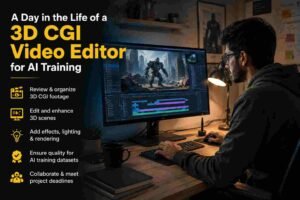
By midday, you’re into the educational clip. Audio sync issues on 3D animated content can get tricky when the render and the sound were processed separately — you know the fix, you run it, done. The motion graphics element takes a bit longer because the feedback notes were vague, so you send a quick message asking for clarification rather than guessing and wasting an hour.
By afternoon, you’re iterating on a new asset — building it from scratch this time, following the brief. The CGI video production workflow here is tight: brief, rough cut, feedback, revision, final delivery. Repeat. It’s methodical work, but if you enjoy the craft of editing and want your skills to mean something beyond ads and reels, this kind of structured, technical output hits different.
💰 Salary Breakdown by Experience Level
These are market estimates only — not confirmed or guaranteed figures from OpenTrain AI.
| Experience Level | Estimated Hourly Rate |
| Entry / Junior (1–2 years CGI editing) | $30–$40/hr |
| Mid-Level (3–5 years, client portfolio) | $45–$60/hr |
| Senior (5+ years, complex project management) | $65–$80/hr |
At 20 hours per week, a mid-level editor could earn roughly $3,600–$4,800 per month — working part-time, from home. For Pakistani freelancers converting to PKR, that’s a significant income even at the lower end of the range.
📩 How to Apply
Ready to go for it? Head over to TopicEarn.com and hit the apply button on this listing. That’s the only place you need to be — everything runs through there. Make sure your profile highlights your 3D CGI and animation editing experience clearly, because that’s exactly what reviewers will be looking at first.
❓ People Also Ask

Do I need AI experience to apply for this role?
No, you don’t. OpenTrain AI is clear about this — prior AI training work is not a requirement. What they care about is your actual video editing background. If you’ve done serious 3D CGI and animation work in a professional or client setting, your skills already match what this role needs.
Is this job available to applicants from Pakistan?
Yes, fully. The role is listed as worldwide eligible and 100% remote, which means location is not a barrier. As long as you have the right experience and a reliable internet connection, you can apply from anywhere in Pakistan.
What software do I need to know?
You should be comfortable with at least one professional editing tool — Adobe Premiere Pro, After Effects, DaVinci Resolve, Final Cut Pro, or Avid Media Composer. These are the main 3D CGI video editing software platforms this type of work runs on. Knowing more than one is always a plus.
How does the pay actually work — is it consistent?
This is a contractor role, so pay is hourly and based on the hours you log. There’s no fixed monthly salary. If the project volume is steady, your income will be steady. If work slows down, so does the pay. It’s freelance-style flexibility, which works well for some people and not for others.
What kind of portfolio should I have ready?
Anything that shows real 3D CGI editing work — robotics visuals, animation projects, motion graphics reels, compositing samples. Client work carries more weight than personal projects, but strong personal work still counts. The key is showing that your 3D CGI video editor skills are at a professional level, not just hobbyist.
🌟 OpenTrain AI — Where Creative Skills Power the Future of AI
OpenTrain AI is quietly building the human side of artificial intelligence — and they need editors like you to help get it right. If your craft is strong and you’re ready to put it to work in a space that actually matters, this could be the right move.